
CSRC Newsletter - Fall 2025
Volume 24, Number 2
Director’s Message
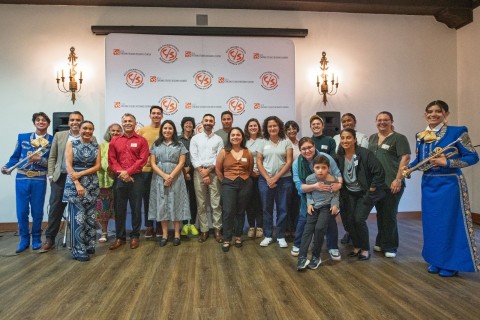
CSRC Director Veronica Terriquez (third from left) and recently hired UCLA faculty at
the CSRC Faculty Advisory Committee’s fall quarter reception, October 13, 2025. (CSRC)
The end of this tumultuous calendar year offers us the opportunity to reflect on the vision guiding the Chicano Studies Research Center and the meaningful work we have advanced together through collaborative efforts. Since assuming leadership, I have drawn on the foundational Chicano studies scholarship alongside the innovative work emerging in Latinx studies today. These longstanding and evolving frameworks remind us that rigorous research must incorporate the experiences of students, educators, and communities whose perspectives have not been adequately reflected in academia.
I also maintain the conviction that ethnic studies is essential across all fields—from the humanities to health, engineering, law, business, and the physical sciences. For example, understanding the histories, challenges, and accomplishments of US-based communities with ties to Mexico and other countries in Latin America is vital for advancing effective public policy, humane immigration practices, quality health care, and economic opportunity; mitigating the harms of climate change; and promoting thoughtful oversight of emerging technologies such as artificial intelligence. A society grounded in this knowledge is better equipped to address pressing challenges and imagine better solutions.
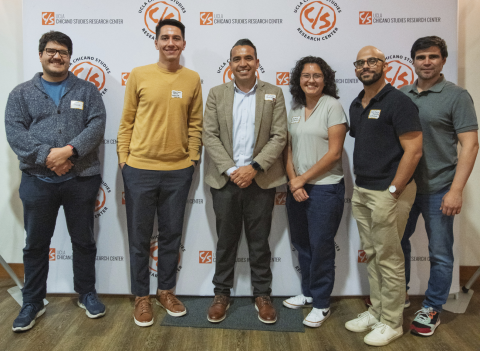
CSRC-affiliated professors and postdoctoral scholars from the UCLA Department of
Chemistry and Biochemistry at the CSRC Faculty Advisory Committee’s fall quarter
reception, October 13, 2025.* (CSRC)
With much thanks to supportive campus leaders and a dedicated staff, we have safeguarded our operations in the face of crisis, strengthening our multidisciplinary scholarly network at UCLA and beyond. The CSRC remains a generative space for mentorship, collaboration, and research. Under the leadership of Professor Osvaldo Gutierrez, the CSRC’s faculty director of STEM initiatives, we have deepened our engagement in STEM fields.
Through the Latina Futures 2050 Lab, we have continued to support talented scholars and community partners, enabling us to address a spectrum of issues—including the Latina wage gap across California counties, the displacement of Latina farmworkers, intergenerational mobility, queer and trans Latina experiences, immigrant rights, and disability justice. In November we partnered with the Coalition for Humane Immigrant Rights (CHIRLA) to welcome nearly 150 college students from across the state with the shared goal of supporting their leadership development. Currently, we are collaborating with Visual AIDS, ONE Archives, and the Museum of Contemporary Art (MOCA), to present “Last Address Tribute: Los Angeles.” Taking place on December 20, this bus tour will honor late individuals whose community-based work and activism are critical to our knowledge and understanding of the AIDS epidemic. During stops in East Los Angeles and at MOCA and ONE Archives, tributes will be given for art photographer Laura Aguilar (1959–2018), poet Gil Cuadros (1962–1996), artist and filmmaker Ray Navarro (1964–1990), and former CSRC librarian Yolanda Retter (1947–2007).
Meanwhile, the CSRC Library continues its critical role as a premier archival repository. Two students supported by the Gandara Undergraduate Internship Program are digitizing, cataloging, and curating materials for an upcoming Latina Futures digital library project. On December 6, CSRC librarian and archivist Xaviera Flores discussed the CSRC Library’s graphic art collections at “Historias Radicales: Latinx Identity and History in Southern California,” a conference held in conjunction with Radical Histories: Chicano Prints from the Smithsonian American Art Museum, an exhibition at the Huntington Library in San Marino, California. The current CSRC Library exhibition, ¡Somos Súperpoderosxs! Latines in Comics, which is drawn from the library’s Latinx Comics and Visual Literature Collection, has been extended through March 2026.
The CSRC Press remains a leading source of scholarship that shapes academic and public discourse. Amalia Mesa-Bains: Rituals of Memory, Migration, and Cultural Space, the latest volume in the A Ver: Revisioning Art History series, earned a gold medal for Best Arts Book from the International Latino Book Awards this fall, adding to the many recognitions received by CSRC Press. We would like to thank Charlene Villaseñor Black, who was recently named Loevner Fellow and Tutor in History of Art at Worcester College, Oxford University, for her ten years of visionary leadership of Aztlán: A Journal of Chicano Studies, the flagship journal in the field. Under her direction, the journal continued to rise in national prominence and became a copublication of CSRC Press and University of California Press. We are thrilled to announce that Joshua Javier Guzmán, associate professor of gender studies at UCLA, will be Aztlán’s new editor in chief starting in January 2026.

CSRC director Veronica Terriquez and student leaders of the CSRC’s California Freedom
Summer Participatory Action Research Project and Power California at a convening in
Fresno, California, on September 6, 2025. (CSRC)
The CSRC’s multidisciplinary approach to research and programming is affirmed every time I meet with UCLA students and prospective applicants who are part of our California Freedom Summer Participatory Action Research Project. They include students like Leticia Alicon, a UCLA transfer student from Los Angeles Trade Technical College, who is conducting research on labor rights; Judy Bravo from College of the Sequoias, who is active in the nonprofit FemSTEM and aspires to become an engineer for social good; Kelly Melendez, a visual artist from Bakersfield; Angelo Medrano, a student in Salinas who is deeply committed to studying the history of the United Farm Workers (UFW); and Enrique Morales, a high school student leader from Lompoc, who recently completed his college applications with plans to study statistics. These students recognize the importance of understanding their communities’ histories, and they are pursuing their academic goals with a clear commitment to broader community uplift. At UCLA, they can connect with CSRC-affiliated faculty who not only support their individual success but also share their dedication to the community. The CSRC stands with advocates and community members who are continuing to fight for greater access, including those who are at the forefront of defending legislation such as AB540 and the California Dream Act which provide in-state tuition and state financial aid for all who qualify.
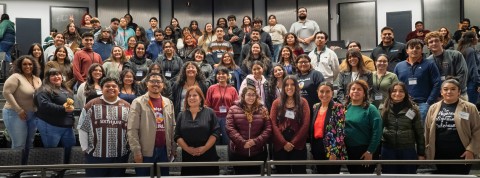
CSRC’s Latina Futures 2050 Lab hosts student leaders at a conference organized by
Coalition for Humane Immigrant Rights (CHIRLA), November 14–16, 2025. (CSRC)
If 2025 taught us anything, it is not to take anything for granted. As we move into 2026, I remain focused on strengthening our scholarly community and expanding pathways for research and opportunity. A key component of this work will be fundraising, especially as the national political landscape increasingly requires us to be self-reliant. I welcome your partnership in ensuring the longevity and vitality of the CSRC as it enters its fifty-seventh year.
I wish you and your loved ones a restorative winter break and renewed strength in the new year. As we look toward 2026, we recognize the important work before us, particularly as our nation’s institutions—including higher education—navigate a period of uncertainty. In this moment, our deepening partnerships strengthen our ability to pursue truth, advance knowledge, and serve our communities. I am profoundly grateful to all of you who continue to support our vital work.
¡Felices Fiestas!
Veronica Terriquez
Director and Professor
*(L-R) Emilio Leal Cárdenas, UCLA Chancellor’s Postdoctoral Fellow; Antonio Tinoco Valencia, assistant professor; Osvaldo Gutierrez, professor; Jazmin Aguilar-Romero, assistant teaching professor; Kevin Enrique Rivera Cruz, UC President’s Postdoctoral Fellow and NSF MPS-Ascend Postdoctoral Fellow; and Jose Rodriguez, associate professor.
News
California Freedom Summer 2025 in California’s Central Valley
This past summer, the CSRC welcomed a cohort of twelve youth leaders to participate in civic engagement and action research in California’s Central Valley as part of the California Freedom Summer Participatory Action Research Project (CFS). These undergraduate students from UCLA, UC Merced, UC Santa Cruz, UC Davis, and Porterville College worked with 200 Central Valley youth to develop their skills in action research, leadership development, community organizing, and grassroots movement-building. Additionally, the leaders collectively interviewed one hundred Central Valley youth to learn about their local civic priorities, where they get their news, what motivates them to get involved in their communities, and the barriers and motivators to civic engagement. As part of their participation in CFS, the youth leaders also held summer internships at nonpartisan community-based organizations across the Central Valley.
CSRC trains FLA fellows in the Central Coast
During the summer, the CSRC partnered with the Future Leaders of America (FLA) Civic Engagement Fellows (CEF) program, which supports high school and community college youth leaders living in the Central Coast. The CSRC helped FLA conduct a pilot research project to train CEF fellows in youth participatory action research methods. The fellows interviewed over fifty young people in Oxnard, Lompoc, and Santa Maria to learn about barriers to and motivators for civic engagement in their communities. Altogether, the CSRC trained twenty high school, community college, and college students to conduct participatory action research in their hometowns. These youth researchers went on to conduct 150 interviews with young people in the Central Valley and Central Coast. The researchers will share their findings with youth organizations this spring.
CSRC prepares for CFS 2026
Following the success of CFS 2025, the CSRC spent the fall establishing partnerships with community colleges and community-based organizations across California to encourage participation in CFS 2026. We have already received over 330 applications from high school, community college, and University of California students interested in taking part in next summer’s program. As part of CFS outreach efforts, the CSRC hosted thirty high school students from Future for Lompoc Youth, a Lompoc youth empowerment organization, for a UCLA campus visit on October 30. Students learned about college admissions and student life and received a campus tour from CFS participant Linsey Rodriguez, who also spoke about her experience in the project. In another outreach effort, the CSRC partnered with environmental justice community organizations UNIDOS Network and Sequoia Environmental Educational Directive (SEED) for a tour on December 6 of hazardous environmental sites and conditions in the rural communities of Kettleman City, Lost Hills, and Buttonwillow in the Central Valley. CFS participants from Porterville College and College of the Sequoias attended and supported the event.
For more information about CFS, visit the CSRC website and follow CFS on Instagram. CFS is spearheaded by the CSRC in partnership with the American Indian Studies Center, Asian American Studies Center, and Ralph J. Bunche Center for African American Studies within the UCLA Institute of American Cultures. In 2025, CFS has been generously supported by The California Endowment, the Stuart Foundation, the UCLA Gold Shield Alumnae, and individual donors.
Ethnic studies teacher training survey published
In late 2024 and early 2025, Veronica Terriquez, CSRC director, and Albert Camarillo, professor of history, emeritus, at Stanford University, led a survey that explored the status of ethnic studies instruction in education degree programs offered at California’s universities. The research was conducted in response to Assembly Bill 101, which was signed into law in 2021 and makes the completion of a one-semester ethnic studies course a graduation requirement for all California high school students, starting with the class of 2030. Respondents to the survey were from administrators of education degree programs at thirty-four institutions across the state, including University of California and California State University campuses as well as private institutions. The study reveals that three out of four of the schools surveyed offer ethnic studies preparation for future K-12 educators. It also shows, however, that current ethnic studies instruction is not comparable across institutions and that no additional state funding exists for this work. The report, Advancing Ethnic Studies in California High Schools: A Survey of Teacher Preparation Programs, was published this fall and is available as a PDF on the CSRC website. The survey was conducted through a collaboration between Stanford University's Institute for Advancing Just Societies, Stanford University’s Center for Comparative Studies in Race and Ethnicity, UCLA's Institute of American Cultures ethnic studies research centers (American Indian Studies Center, Asian American Studies Center, Chicano Studies Research Center, Ralph J. Bunche Center for African American Studies), and UCLA’s Center X in the School of Education and Information Studies.
Gutierrez named inaugural chair
Osvaldo Gutierrez, professor of chemistry and biochemistry and inaugural CSRC Senior Hispanic Serving Institution (HSI) Faculty STEM Director for UCLA, has been named the inaugural Fraser and Norma Stoddart Chair in Contemporary Chemistry, effective July 1, 2026.
Library
CSRC Library supports rare book courses
This fall, the CSRC Library provided onsite learning for two class groups from the California Rare Book School (CalRBS), a nondegree program of the UCLA Graduate School of Education and Information Sciences. One course, taught by Emily Drabinski, associate professor and chair of the Queens College Graduate School of Library and Information Studies at the City University of New York, focused on the practice of critical librarianship. The other, taught by Charles Hatfield, professor of English at California State University Northridge, focused on the social and material lives of comic art.
CSRC Library welcomes first cohort of Gandara interns
This fall, the CSRC Library welcomed the first cohort of students in its Gandara Undergraduate Internship Program (GUI): Marissa Bermudez, a fourth-year student majoring in Chicana/o and Central American studies, and Nathalie Escobedo, a fourth-year student double-majoring in Chicana/o and Central American studies and art history. Interns provide support to the CSRC Library on new and ongoing projects while receiving comprehensive training in critical areas of librarianship, such as digital preservation, reference, instruction, outreach, and programming. The GUI program is made possible at the CSRC by a generous endowment and continued support from Daniel and Juleann Gandara.
Flores speaks at conference
CSRC librarian and archivist Xaviera Flores presented at the conference “Historias Radicales: Latinx Identity and History in Southern California” at the Huntington Library on December 6. Flores spoke about her work developing the CSRC Library’s visual literature collection of graphic arts, political cartoons, and comics, and the role these art forms play in documenting the experiences of Latines in American history. The conference was presented in conjunction with the exhibition Radical Histories: Chicano Prints from the Smithsonian American Art Museum. CSRC lent to the exhibition audio excerpts from the oral history of Los Angeles artist Barbara Carrasco conducted by Karen Mary Davalos, professor of Chicano and Latino studies at the University of Minnesota, Twin Cities. The transcript was published by CSRC Press.
Library exhibition extended
The CSRC Library exhibition ¡Somos Súperpoderosxs! Latines in Comics, featuring materials from the CSRC’s Latinx Comics and Visual Literature Collection, has been extended through March 2026. The exhibition is on display in the library and hallway vitrine.
Changes to library services and hours
Due to recent budget and staff cuts, the CSRC Library team’s roles and responsibilities have been restructured to best support students, resulting in the reduction or suspension of some library services until October 1, 2026. Library staff are no longer scheduling onsite archival research visits and fulfilling museum loan requests for non-UCLA-affiliated patrons. Questions should be directed to Celia Lacayo, CSRC assistant director, at clacayo@chicano.ucla.edu.
The CSRC Library will be closed starting December 12, 2025, for the winter break. It will reopen January 5, 2026, with general library hours Monday, Tuesday, Thursday, 12:00 p.m.–5:00 p.m. and Wednesday, 10:00 a.m.–5:00 p.m.
CSRC Library and archival services are made possible in part by grants and individual donations. Please consider donating online to the CSRC Library Fund to help us continue our services.
Press
New Aztlán editor announced
The CSRC is pleased to welcome Joshua Javier Guzmán, associate professor of gender studies at UCLA, as the new editor of Aztlán: A Journal of Chicano Studies. Guzmán succeeds Charlene Villaseñor Black, former UCLA professor of art history and Chicana/o and Central American studies, who served as editor since 2016. Guzmán will begin his tenure in January 2026. Aztlán, founded at the CSRC in 1970, is an interdisciplinary, double-blind peer-reviewed journal. Published twice yearly, Aztlán is now copublished by CSRC Press and University of California Press and is available in print and digital formats.
CSRC Press wins ILBA
Amalia Mesa-Bains: Rituals of Memory, Migration, and Cultural Space by Tomás Ybarra-Frausto earned a gold medal for Best Arts Book in the 2025 International Latino Book Awards (ILBAs). The book is volume 13 in the A Ver: Revisioning Art History series from CSRC Press. The series is distributed by University of Minnesota Press.
CSRC In the News
Stanford School of Humanities and Social Sciences, December 15, 2025
NYU Department of Performance Studies, December 11, 2025
UC Spotlight, December 10, 2025
UCLA Department of Chemistry and Biochemistry, December 11, 2025
UC Santa Cruz News, December 5, 2025
Los Angeles Times, December 4, 2025
UCLA Newsroom, November 26, 2025
UCLA Department of Chemistry and Biochemistry, November 18, 2025
UCLA, November 14, 2025
UCLA Luskin School of Public Affairs, November 12, 2025
UCLA Newsroom, November 11, 2025
Daily Bruin, November 6, 2025
Santa Cruz Sentinel, November 3, 2025
X as Intersection: Writing on Latinx Art, October 29, 2025
Time, October 28, 2025
West LA Times, October 17, 2025
UC Merced Newsroom, October 13, 2025
Sierra Sun Times, October 9, 2025
UCLA Newsroom, October 8, 2025
UCLA Newsroom, October 1, 2025
UCLA Newsroom, September 15, 2025
Latino News Daily, August 21, 2025
MSN, August 5, 2025
Phys.org, August 5, 2025
UC Merced Newsroom, August 4, 2025
Los Angeles Daily News, August 2, 2025
Hyperallergic, July 28, 2025
CALÓ News, July 25, 2025
The Porterville Recorder, July 18, 2025
The Austin Chronicle, July 18, 2025
Boyle Heights Beat, July 12, 2025
UCLA Luskin School of Public Affairs, July 7, 2025
MSN, July 3, 2025
LAist, July 3, 2025
LAist, July 3, 2025
The UCLA Chicano Studies Research Center acknowledges the Gabrielino/Tongva peoples as the traditional land caretakers of Tovaangar (the Los Angeles basin and So. Channel Islands). As a land grant institution, we pay our respects to the Honuukvetam (Ancestors), ‘Ahiihirom (Elders) and ‘Eyoohiinkem (our relatives/relations) past, present and emerging.