![]() |
![]() |
![]() |
![]() |
![]() |
![]() |
|
|
CSRC Research Report Archive |
|
The CSRC Research Report series presents in-depth research analyses on issues of interest to Latinos and Chicanos. All reports, including the latest releases, are available in PDF. |
|
|
The Latino Workforce at Mid-Decade Lisa Catanzarite and Lindsey Trimble No. 10, November 2007 The Latino workforce is increasingly critical to the vitality of the U.S. economy. Despite the importance of Latinos in the labor market, their economic contributions are limited by significant disadvantages. This research report provides an overview of Latino workers in the United States at mid-decade. |
|
Latina/o Transfer Students: Understanding the Critical Role of the Transfer Process in California’s Postsecondary Institutions Martha A. Rivas, Jeanette Peréz, Crystal R. Alvarez, and Daniel G. Solorzano No. 9, May 2007 Latino students continue to be underrepresented in postsecondary education. For every 100 Latina/o elementary students, 11 will graduate from college, 4 will receive a graduate degree, and only 1 will receive a PhD. This research report explores the obstacles that Latina/o students face as they move through the education pipeline and examines the importance of the transfer process from community college to a four-year college or university. |
![]() |
The Accidental Arts Supporter: An Assessment of the Comprehensive Employment and Training Act (CETA) Mirasol Riojas No. 8, May 2006 The comprehensive employment and Training Act (CETA) is often credited as a significant source of funding for emerging minority and community-based arts organizations in the 1970s. unfortunately, much of this history is anecdotal. This study examines available data to assess the impact of CETA on the arts as a whole, rather than on particular arts organizations and/or programs. |
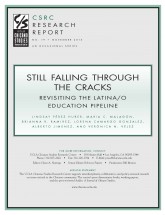
Falling
through the Cracks: Critical Transitions in the Latina/o Educational Pipeline:
2006 Education Lindsay Pérez Huber, Ofelia Huidor, María C. Malagón, Gloria Sánchez, Daniel G. Solórzano No. 7, March 2006 The U.S. educational pipeline functions well for some groups of students, allowing them to flow smoothly through the various levels of education and yielding a fairly proportionate number of high school and postsecondary graduates. The pipeline for Latina/o students, however, does not work in this way. This report examines the research literature on critical transitions within each segment of the educational pipeline—K-12, community college, undergraduate, and graduate—and offers recommendations for policies that, if implemented, will increase the number of Latina/os who graduate with advanced degrees. Prepared for the conference on the topic. See also the policy brief on the topic. |
|
Identifying and Preserving the History of the Latino Visual Arts: Survey of Archival Initiatives and Recommendations Tracy Grimm, Institute for Latino Studies, University of Notre Dame No. 6, April 2005 This report includes a nationwide
survey of recent Latino arts archival initiatives designed to prevent
the loss |
|
Minority Filmmakers, Media Institutions, and Press Discourse: A Comparative Analysis Hye Seung Chung and Jun Okada, with assistance by Maja Manojlovic No. 5, January 2005 Film scholarship has a bias toward studying mainstream movies, especially Hollywood film, and ignoring minority participation. By analyzing five film magazines, this study collates press coverage of the last quarter century of African American, Asian American, Latino/Chicano, and Native American participation in other mediums, including avant-garde film, video art, documentary, short narrative, and public affairs television. Findings were that despite clear efforts to represent minority cinema, there was a significant lack of reporting on Latino/Chicano and Native American cinema. A comprehensive bibliography is provided. |
|
![]() |
Looking For Latino Regulars on Prime-Time Television: The Fall 2004 Season Alison R. Hoffman and Chon A. Noriega No. 4, December 2004 The appearance of Latino regular characters on network prime-time television has steadily decreased over the last three years. Latino regular characters appear in just one of the eight series set in Los Angeles County, a region with a 45% Latino population. Latino regular characters account for just 8% of the regular characters on the 16 series set in New York City, a city with 27% Latino population. 50% of Latino regular characters can be found on ABC programs.
|
![]() |
Looking For Latino Regulars on Prime-Time Television: The Fall 2003 Season Alison R. Hoffman and Chon A. Noriega No. 3, April 2004 Latinos now comprise the largest minority group in the country, yet register as the most underrepresented group in prime-time. 75% of prime-time's regular characters are white and white characters can be found on 95% of all prime-time series. Yet only 15% of shows include Latino regular characters. Although more minorities appear on prime-time this year, the number of Latino characters has remained constant. Latinos remain highly segregated on the programming schedule, appearing on just 5 out of 12 genres. |
![]() |
An Undocumented History: A Survey of Index Citations for Latino and Latina Artists Rita González No. 2, August 2003 Emerging out of the civil rights struggles of the 1950s to the 1970s, Latina/o artists created both institutions and artwork in the service of their communities. The institutions included nearly a dozen art museums and several hundred grupos, centros, and galerias nationwide. The artwork provided the visual vocabulary for social protest, cultural identity, and historical awareness. In addition to representing community-based political activism, Latina/o art challenged and engaged the art world, promoting changes in historiography, influencing contemporary debates, and validating new practices. Despite these accomplishments, Latino artists and institutions have yet to be adequately integrated into art historical scholarship. Our findings reveal a significant lack of literature on active and successful Latino artists. Attempts to highlight the contributions of Latina/o artists have been made in digital databases, exhibition catalogs, survey histories, and reference encyclopedias. Recent book-length studies have explored the politics of exhibition as related to Latino art and arts spaces (see fig. 3). However, few monograph publications and scholarly articles detail the work of individual artists. |
![]() |
Looking for Latino Regulars on Prime-Time Television: The Fall 2002 Season Alison Hoffman No. 1, March 2003 On any given night of the week between 8:00 and 11:00 P.M., prime-time television programming can be seen lagging behind U.S. social realities. Its failure to include minorities in regular roles that reflect the plurality of the American public grows visibly more dramatic every year. In the 2002 season fall line-up, the vast majority of network, prime-time, regular characters were white and only 4 percent were Latino. Yet, nationally, Latinos make up 13 percent of the national population, three times their representation on television, making them among the most underrepresented minority groups on television. The viewing landscape of prime-time television is in urgent need of a more consistent inclusion of Latino and other minority regular characters. |
|