Acknowledgements
Learning to Lead: Youth Organizing in Immigrant Communities reflects a long-standing commitment to understanding how young people develop the skills and collective capacity to advance positive community change. This project draws deep inspiration from the organizing efforts of Youth Together members at Skyline High School in Oakland at the turn of the millennium. Although the project took many years to fully develop, it ultimately came to life through research conducted in communities across California during the 2010s. This work would not have been possible without the insight, generosity, and collaboration of many individuals and organizations, including those acknowledged here.
I am deeply grateful to the young people, mentors, and community members who shared their experiences, participated in surveys and interviews, and reflected on their experiences. Their stories and leadership are at the heart of this book. Carolyn Hernandez, Lian Cheun, Halima Musa, Irvis Orozco, Citlali Ruiz, David Phan, Brandon Najera, Tsim Nuj (Eugene) Vang, Lilibeth Ramirez were especially generous in sharing their experiences.
This research would not be possible without the many student and youth researchers who joined me in the field and contributed their energy and commitment at every stage of the project. I owe particular thanks to May Lin (then a graduate student at the University of Southern California) and Uriel Serrano (then a graduate student at UC Santa Cruz), who were invaluable thought partners during data collection and analysis in Southern California and beyond. Research in the Inland Empire and Eastern Coachella Valley benefited enormously from the contributions of Rocio Aguayo, Olivia Rodriguez, Denise Armijo, Ivy Valdez, and Aurora Saldivar. Betania Santos and Angelica Quintana played key roles in research on youth organizing in Santa Ana.
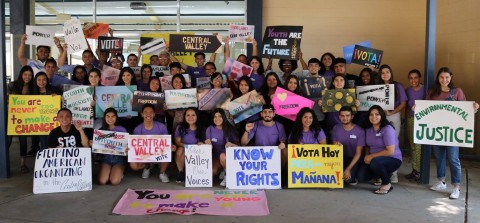
In California’s Central Valley, Randy Villegas—then a graduate student at UC Santa Cruz and a youth organizer since middle school—provided extraordinary leadership and helped launch the Central Valley Freedom Summer Participatory Action Research Project. I am also grateful to Roxanna Villalobos for coordinating student researchers, and to Jim Keddy, Alicia Olivarez, Sergio Cuellar, Chrisantema Gallardo, and Jasmine Leiva for helping deepen my understanding of the region. I also thank Aria Zapata, Jose Orellana, Rosania Paniagua, Angelina Santiago, Valeria Mena, Jared Semana, Melissa Figueroa, Jose Pinto, Alyssa Castro, Joshua Barrientos, Julian Rodriguez, Mai Lee, Gurbinder Singh, Kathy de la Cruz, Amy Perez, Crystal Gomez, Ofelia Rojas, Lydia de la Riva, Gustavo Tellez-Mendez, Lidia Gonzalez, and Valeria Cervantes for their commitment to their communities and their assistance in documenting youth civic engagement efforts. At UC Santa Cruz, the sociology department, Institute for Social Transformation, and Sue Grasso played an invaluable role in working with so many students and facilitating this research. I am grateful to Robin de Lugan for her partnership in working with UC Merced students.
On the Central Coast, Eder Gaona-Macedo played a crucial role in facilitating and contextualizing the research. I also thank Ivan Vega, Nicole White, Elias Solorio, Ruben Espinosa, and Ana Mendoza for their assistance in gathering and interpreting data from young people and organizations in the region.
I am grateful to the first cohort of graduate students who helped launch this line of research in 2011: Christina Chin, Hyeyoung Kwon, William Rosales, Caitlin Patler, Jeff Sacha, Claudia Solari, and Karina Chavarria, then graduate students and now accomplished researchers and educators.
As undergraduates, Gabriela Dominguez (USC) and Steven Carmona Mora (UC Santa Cruz) played important roles in managing data collection and analysis, helping sustain strong survey response rates and data quality among peer researchers. Jiayi Xu shared her technical expertise in experimental and longitudinal data analysis. Undergraduate researchers from USC, UC Santa Cruz, and other institutions—including Evelyn Larios, Ana Gomez, Lanisha Butler, Jazmine Miles, Jennifer Soto, Nyereath Nhial, Rabiah Almajid, Marlen Reyes, Erick Gasca, Miguel Carvente, Ariana Verdu, Luna White, Emily Macer, Isabel Dueñas, Courtney Howard, Christopher Yik, and Adriana Villegas—contributed careful data collection and thoughtful analysis. Uriel Rivera, Angel Ross, Claudia Rodriguez, Hector Plascencia, and Alejandra Vargas-Johnson provided essential support in gathering and contextualizing data from immigrant students.
Research interns supported through the Building Healthy Communities initiative of The California Endowment also made meaningful contributions to refining survey instruments, collecting data, and contributing to reports. I am grateful to Lupe Renteria, Marylou Chavez, Angeli Hernandez, Miriam Hernandez, Kaelyn Miuru, Bobby Powell, Manuel Saavedra, Alexandra Girissel-Gomez, Andrea Ramirez, Ajay Lawson, Stephanie Abrego, Xavier Gantt, Lupita Gutierrez, Johnny Rodriguez, Alfred Craig, Jazmin Casas, Yasmin Marquez, and Yahaira Medrano.
I also truly enjoyed involving high school students in this research. Connor Regan, Abdiel Lopez, and Etai Rogers brought enthusiasm and commitment that left a lasting impression. During the pandemic, Sinaya Joshi served as the primary high school research assistant and demonstrated remarkable dedication under difficult circumstances. I am especially thankful to UCLA undergraduate researcher Jeannette Ciudad-Real, who prepared charts, managed references, and completed many final tasks that helped bring the project to completion.
A central component of Learning to Lead involved grounding the analysis in the historical development of the youth organizing field. I was privileged to speak with individuals who played formative roles in shaping youth movements and who shared intergenerational insights drawn from many years, and sometimes decades, of social justice work. In the Bay Area, I am especially grateful to Margaretta Lin, Jidan Koon, Jay Conui, Millie Cleveland, Warrick Liang, Margaret Brodkin, Tony Douangviseth, Jamileh Ebrahimi, Nahid Ebrahimi, Raquel Jimenez, Prishni Murillo, Kimberly Aceves, Joshua Lee, Stanley Punn, and Rhummanee Hang. In Southern California, I thank Maria Brenes, Elmer Roldan, Nancy Meza, Jennifer Maldonado, Alberto Retana, Eric Mann, Aurea Montes, Tom Dolan, Dianna Ross, Gloria Soto, Pedro Trujillo, Abraham Medina, Claudia Perez, Dulce Saavedra, Tony Ortuño, Carlos Perea, Jonathan Paik, and Rafael Solorzano for sharing their expertise and long-standing commitments to the field.
I also benefited from conversations and partnerships with key experts. Luis Sanchez, executive director of Power California, generously shared reflections and materials that enriched my understanding of the field’s early development. I learned as well from informal conversations with Jeremy Lahoud, Roque Armenta, J. Ishida, Linda Sanchez, Grisanti Valencia, and Ashley Uyeda. Eric Braxton was a valuable sounding board as I worked to situate this research nationally. I appreciated the opportunity to collaborate with Siomara Valladares, Michelle Renee Valladares, and the CU Boulder Research Hub for Youth Organizing, as well as FCYO staff, on the national youth organizing field scan. Laura Gil-Trejo and her team at the Cal State Fullerton Social Science Research Center conducted exemplary data collection for the 2011 CYAS survey.
The scholarship of those who have long advanced our understanding of immigrants, youth of color, and working-class communities shaped my analysis. I am especially grateful to Manuel Pastor for championing this research and to his team at the University of Southern California Equity Research Institute (ERI) for their partnership and support. ERI provided an intellectual and institutional home that made possible the publication of more than forty co-authored reports on youth organizing, as well as ongoing thought partnership and infrastructure for research aligned with social movements. I also thank John Rogers, the late Jeannie Oakes, Ruth Milkman, Pedro Noguera, Paul Ong, and Irene Bloemraad, each of whom helped shape how I approached the questions at the heart of this book.
I also benefited from the scholarship and guidance of Ben Kirshner, Mark Warren, Joe Kahne, Cathy Cohen, Shawn Ginwright, Connie Flanagan, Arely Zimmerman, and Robert Courtney Smith. I am particularly appreciative of Genevieve Negrón-Gonzales, Cristina Mora, Maria Rendón, Edelina Burciaga, Erica Hodgen, Daniel Martinez HoSang, Andreana Clay, Vanessa Carter, and Jennifer Ito for feedback on select chapters. I am indebted to the USC Equity Research Institute for supporting the publication of more than forty co-authored reports on youth organizing and for providing the infrastructure to engage in research aligned with social movements.
This research was supported by generous funding from The California Endowment, the Irvine Foundation, the Weingart Foundation, the Spencer Foundation, the Bill and Melinda Gates Foundation, and the Sierra Health Foundation. I am especially appreciative of Albert Maldonado, former Program Manager at The California Endowment, for his insights into youth organizing across California and his enthusiasm for this research. Mona Jhawar was an exceptionally supportive program officer who, along with other colleagues at TCE, offered invaluable guidance. I was honored that Dr. Bob Ross, Fred Ali, Marty Jimenez, and the late Beatriz Solis engaged thoughtfully with this work. I also benefited from the time and intellectual community provided by the Stanford Center for Advanced Study in the Behavioral Sciences while working on drafts of the manuscript.
Finally, I thank Suzanne Nichols, Joanna Dreby, Leslie Paik, the Rose Series workshop participants, and the Rose Series editors for their constructive engagement. I am deeply grateful to Matt Seidel for carefully copyediting multiple drafts, and to Jesse Lichtenstein and the late Jacqueline Tasch, whose editorial expertise strengthened the manuscript. Mil gracias as well to the UCLA Chicano Studies Research Center staff for reviewing segments of the final manuscript. Monica Iannessa’s boundless encouragement and support helped ensure that I remained focused on this project. And last, but certainly not least, I thank my family, whose love, patience, and care have sustained me throughout this journey.
— Veronica Terriquez, March 2026